
In 1896, gold was discovered in Canada’s Klondike region, and within two years, roughly 100,000 people set out for the north in one of the largest mass migrations in North American history. Most never made it, and most who did never struck it rich. But the Klondike Gold Rush permanently reshaped Alaska anyway – carving towns out of wilderness, building infrastructure that still exists today, and leaving behind a mythology that still shapes how the state thinks of itself. Here’s how a handful of towns went from overnight boomtowns to some of Alaska’s most storied destinations.
Skagway: The Gateway to the Gold Fields
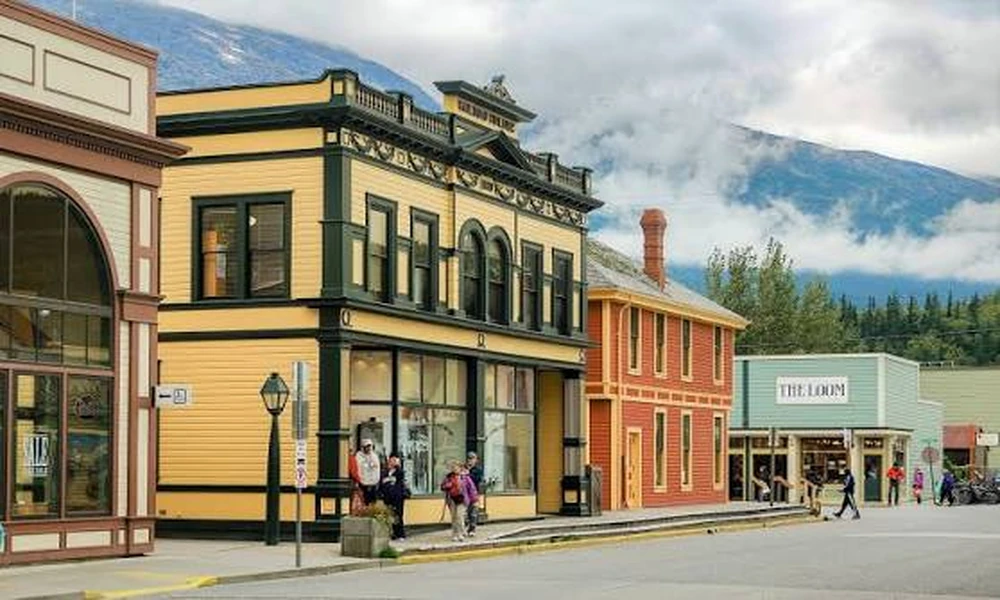
Skagway didn’t exist before the gold rush, and it exploded almost overnight once it started. In 1897, the town went from a handful of residents to roughly 10,000 people within months, as prospectors poured in on their way to the Klondike via the brutal Chilkoot and White Pass trails. Skagway earned a reputation as one of the most lawless towns in the north during this period, largely thanks to con man Jefferson “Soapy” Smith, who ran organized crime operations preying on naive prospectors before being killed in a shootout in 1898. Today, much of Skagway’s historic downtown is preserved as part of the Klondike Gold Rush National Historical Park, giving visitors a genuinely well-preserved look at a boomtown frozen at its peak.
The White Pass and Yukon Route Railway
Built between 1898 and 1900 specifically to solve the gold rush’s brutal transportation problem, the White Pass and Yukon Route Railway was considered an engineering marvel of its time, climbing nearly 3,000 feet in nowhere near enough distance through some of the steepest grades ever attempted by a railroad at that point. The railway made the deadly overland trek to the Klondike dramatically safer and faster, effectively ending the era of prospectors hauling their own supplies over mountain passes on foot. It still operates today as a scenic tourist railway, running the same dramatic route through narrow gorges and past waterfalls that once determined whether prospectors survived the journey north.
Juneau: Gold Before It Was the Capital
Juneau’s gold rush actually predates the more famous Klondike rush by nearly two decades. Gold was discovered there in 1880, and the resulting boom eventually helped make Juneau significant enough to be named Alaska’s capital in 1906, a distinction it still holds despite not being connected to the state’s road system. The Alaska-Juneau Mine, once one of the largest gold mines in the world, operated for decades and left behind mining infrastructure that’s still visible in the hills above town, including the remains of massive ore-processing operations.
Nome: Gold on the Beach
Nome’s gold rush had a detail almost unique in mining history: gold was found directly in the beach sand, meaning no mining claim or equipment was strictly necessary to start prospecting. Word spread fast, and by 1900, Nome’s population had swelled to roughly 20,000, making it briefly one of the largest cities in Alaska. Unlike Skagway’s mountain-pass access, Nome was reached almost entirely by sea, turning it into a chaotic seasonal boomtown that emptied out significantly once the easy beach gold ran out. Today, gold panning on Nome’s beaches is still technically legal and still occasionally practiced by hobbyists and hopeful visitors.
What the Gold Rush Left Behind
Beyond individual towns, the Klondike Gold Rush left a lasting mark on Alaska’s infrastructure and identity. Many of the roads, railways, and town layouts established to move prospectors and supplies became the foundation for the state’s later development. The gold rush also cemented Alaska’s reputation as a place of opportunity and reinvention, a narrative that still shows up in how the state markets itself to visitors today, even though the mining industry that built these towns has long since given way to tourism as the primary economic draw.
Visiting the Gold Rush Trail Today
Because these towns are spread along Alaska’s southeastern coastline and beyond, visiting more than one in a single trip generally means significant travel between stops. Alaskan cruises commonly include Skagway and Juneau on the same itinerary, making it possible to walk the same streets that once saw tens of thousands of hopeful prospectors pass through, all within the same trip and without needing to arrange separate travel between towns that, notably, still aren’t connected by road to much of anything.
For those who want a deeper dive into the history before visiting, detailed archives and interpretive materials on the Klondike Gold Rush, drawn from firsthand accounts and historical records of the period, are worth exploring.
A Rush That Built a State
The gold rush itself was, by most measures, a bust for the vast majority of people who chased it – most prospectors lost money, and only a small fraction ever found meaningful gold. But the infrastructure, towns, and mythology it left behind shaped Alaska far more permanently than the gold itself ever could have. Walking through Skagway’s preserved storefronts or riding the White Pass railway today means walking through the actual physical remains of one of the most frantic, desperate migrations in American history – a story that’s stayed remarkably intact more than a century later.